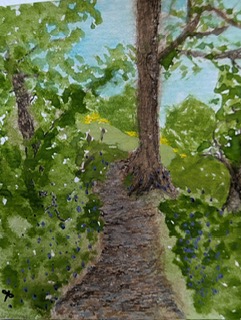
Sketches of Stirling: Four
Our walk today takes us via St. Ninians passing the back of the Robert the Bruce Centre, otherwise known as the ‘Brucie’, across Glasgow Road and on to Yellow Hill. We climb gently into nature, a fresh wind blowing through our hair, the sky above bright blue with patches of white cloud which shadow the gorse-covered Ochils further away.
We come to a ridge fringed with Scotch Broom, its blooms of red and yellow pea-shaped flowers blazing among a profusion of alder, silver birch, oak and white hawthorn in full blossom. The sound of an avion choir arises from the leafy mass: the busy high-pitched flutey ‘too-too’ of the Chaffinch; the Great Tit’s repetitive ‘squeaker-squeaker’ rhythm; the shivering twitter of a wren and the shrill chatter of Dunnock, while the quarking of a crow provides a sombre background. Tiny electric blue Speedwell flowers grow along the earthen path amidst Borage; stems of white Cow Parsley dot the greenery. Ahead of us a Swift rises into the air.
The path leads down to Broomridge, a cluster of modern houses that back onto Yellow Hill and the Bluebell Woods, bordered by Pike Road and the railway line. We don’t stay amongst human habitation for long but head for the woods themselves, hoping for a sight of bluebells three quarters through the month of May.
A series of shallow fortified earthen steps leads us upwards deep into a magical glade. We have entered another world: an enchanted woodland, a veritable conglomeration of ancient trees and other vegetation. Looking back the way we’ve come, the shady, overhanging tree branches frame the downward slope of Yellow Hill, dotted here and there with distant Broom bushes.
In the woods, beech, oak, ash and sycamore trees vie with one another to reach upwards to the light. Rays of sunshine break through an Alder in celestial streams, white Hawthorn flowers peer through the boughs. Delightful fluffy fairy-like cocoons of the Apple Ermine Moth drape themselves across crab apple tree branches like fairy blankets.
We’re entranced by it all: Feather Moss covering a stone, the remains of dying pale green catkins lying across the root-veined path, still beautiful. Then a welcoming robin landing near to us, Cow Parsley and shining Buttercups in glades, a fascinating felled tree trunk containing a central bore hole like a tunnel. One imagines woodland elementals might live there. We pause to admire a white-swathed aphid lying at the apex of nettle stems by dock leaves, harmful to its host but like the ubiquitous moth cocoons, still a work of art.
Further treats lie in store. White Stitchwort with thin grass-like lance-shaped stalks and delicate pink Campion. Even a few remaining bluebells, starved of rainwater after some weeks of continuous sunny weather, pepper the woodland floor in places. A small seat, carved from a tree trunk, a stump with a growth of Peacock Tail fungus and another spikey and clustered by Himalayan Balsam, add to the atmosphere.
White dots float around, refusing to be photographed, blossom petals lie dormant on foliage, angry at death. It’s a woodland of riddles, once an area of historic strife yet no negative atmosphere exists. It seems that nature has overcome this in order to be a place of refuge, not from war but of deep peace.
Our descent from the further end of the wood is via a steep narrow path, somewhat treacherous in places, but we make it safely down to Broomridge then onwards, turning right via a pathway behind the houses to the lower part of Ladywell Park. We find a seat and contemplate dog walkers and the distant circular arched Telford Bridge which passes over the Bannock Burn within the town of the same name. Hearing tinkling watery sounds to our left, we seek out a small wooden bridge and stare into brown foaming water. The burn flows beneath it between overhanging bushes and disappears from view amidst the greenery. It’s hard to imagine that such a feat of nature has given its name to a bloody battle once fought on this terrain. Filled with memories of the Balquhidderock Woods, their true name, we quickly bury such thoughts and proceed homewards.
.