Sketches of Stirling: Six
On this lovely summer’s day we plan to walk from a high point in St.Ninian’s down from the top of Coxithill Road, then continue onwards towards town past Beechwood Park and the police station to Port Street. Our sights are further afield however, beyond the railway line and the River Forth, to the charming hamlet of Cambuskenneth.
Gardens are filled with hydrangeas in pinks and mauves and of the blue lace-cap variety, lifting our spirits in joyful anticipation of the day ahead. On the horizon lies Stirling Castle, the ochre yellow wall of the Great Hall unmistakable from our hilltop view.
Downwards, our pace quickens and some thirty minutes later we are entering Goosecroft Road by the bus and train stations. Then it’s onto the Riverside Bridge over the A9, entering the district of Riverside along the Shore Road which hugs a wide loop of the meandering River Forth. Taking a short cut through the aptly named Forth Crescent, lined on one side by a row of staunch Edwardian villas, we sight two canoeists paddling along the river, watched by a lone person sitting on a park bench, contemplating the view.
The route merges with Abbey Road, where a colourful single story brick building, not far from the river bank, signals Riverside’s boho vibe with its brick structure painted a shade of turquoise. This is contrasted by a gable end and adjacent walls of pale purple, decorated in floral artwork expressing the nature of the business carried out here: Betty Loves Violet. Fresh flowers are produced for every occasion and during Covid the surrounding yard became an outdoor cafe and meeting place when pandemic restrictions were more relaxed.
We aren’t sure why Abbey Road is so named. Perhaps from our destination of Cambuskenneth Abbey which lies ahead across a narrow cobbled footbridge over the river. Or maybe from the evidence found of an early monastery when excavation took place before the construction of modern offices nearer town. The existence of the monastery gave Friar Street, where our favourite Tinkerbell’s Emporium is situated, its name.
From the footbridge the river looks like glass, reflecting the abundance of thick greenery from an array of trees and bushes arising from reedy banks on either side. Puffy cotton wool clouds float just above distant hills, creating a feeling of midsummer restful laziness.
After passing through a children’ s play park we enter the grounds of the thirteenth century abbey, a single tall square bell tower, all that remains, sombre dark against the powdery blue sky. Rays of sunlight, projecting through the fluffy clouds, catch the building’s upper side, sending out shards of diaphanous white light in all directions. Fields of rich yellow corn surround the abbey grounds boundaried by the Ochils, forested on their lower slopes. A wood pigeon, the only sign of life, flies over a five bar gate.
Viewed in the ever changing light from another angle, the abbey’s tall, lancet windows and its light grey brickwork, flecked with flashes of golden stone, present a nobler yet also gentler side. In the coolness of its lofty interior, we stare up at the circular point where the arched roof meets, through which we can see the rafters from where the bell ropes used to hang.
Outside in the sunshine we walk amongst the graveyard. Bones believed to be those of King James the third of Scotland and Queen Margaret of Denmark lay entombed. Other graves pockmark the uneven grassy area, enclosed by speared iron railings, briefly reminding us of the battle ground this area has been part of in the past. But we are not here to dwell on this, preferring to contemplate more uplifting matters. That some holy, spiritual connection exists seems evident when standing at a certain spot, looking back at the city. Straight ahead rise two spires, those of the Baptist Church in Murray Place and the Church of The Holy Rood further up, near the castle. On the same line would once have stood the old monastery.
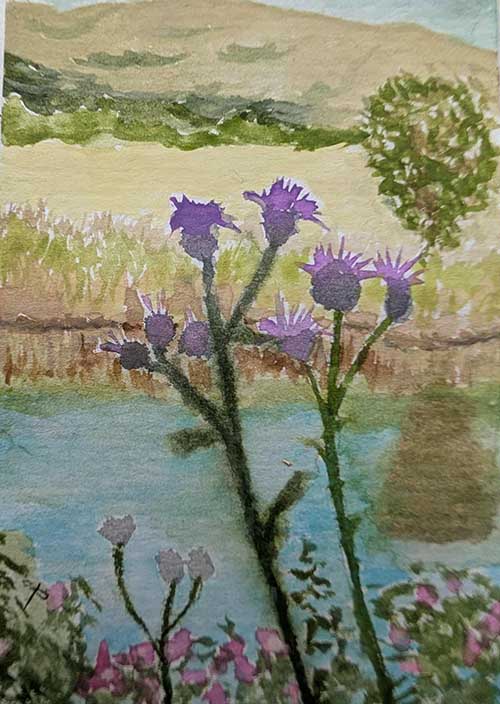
We stroll through the peaceful hamlet, admiring white-washed and grey stone houses, noting the Wallace Monument on the skyline, yet another of Stirling’s great landmarks. Recrossing the old river bridge we turn right, following a path bordered by rose bay willow herb and brambles and thistles, affording peeps across the river to the cornfields and gorse hills.
A paradise of nature in itself, I’m nevertheless unprepared for the Story Garden that lies further along the path on one side of Riverside Park. Set within an arbour of bent willow boughs are semicircled cherry tree stumps. I imagine myself sitting here amongst this fairytale magic, reading aloud, in seventh heaven.
Wandering further along the path a variegated holly tree bears leaves of exquisite mauves and yellow splashed with white light that sparkles like fairy dust against a wrinkled tree trunk. Beds of vibrant flowers greet our eyes: fuchsia-coloured Himalayan Balsam and golden-yellow Ragwort, and wild teasel plants. Round to our right lies the Orchard Garden containing varieties of old apple trees tended by locals.
Time for us to return home, we leave behind the Riverside Naturally project, still a work in progress, and skirt the rest of Riverside, passing under the railway bridge before it crosses over the Forth, filled with a sense of tranquillity.